Showing posts with label Breed. Show all posts

Tuesday, March 26, 2019

Running With Dogs: The Best Dog Breeds For Runners

Dog breeds that are suitable for having a run outdoors with you!


Dogs are referred to as Man's best friend for a ton of viable reasons, and for the most part, it's the companionship that most human's enjoy. While most Dogs may enjoy outdoor activities as much as we do, not all breeds are suitable, be sure to check in with your Veterinarian to confirm that your Doggo's overall health is capable of withstanding such exercises!

Fancy yourself an avid lover of long distance running, or even a regular jogger? 
Woman running with Dog
via AHChealth


Prepping For a Run With Your Dog

Hydration — Even for Dogs that fair well in warm climates, water is essential to keep yourself and your Pet(s) hydrated during exercise. Always have ample water available on hand. 

Rest — Take a few quick breaks during your run or jog, it gives your Doggo(s) a good breather too!

On Leash — It isn't so much about your Dog's capability of staying close, but if you are planning to run in a public area, it's always safer to have them on leash at arm's reach, just in case ☺

Prudence — There's no harm in being cautious and aware of your surroundings, avoid areas that could be potential hazards especially on the first running-trial with your pooch, i.e. steep or difficult terrains, wild animals etc. 


Popular Dog Breed for Runners


If you are in search for a Dog breed suited for those activities, or if you already have a sweet Doggo, you might want to take a look at the following list for the top picks (in no particular order), best known for stamina, high-energy, and obedience necessary in accompaniment on a good run! 

Labrador Retriever

Labs aren't just great at retrieval, they make excellent family pets that provide companionship in most situations. Along with its sturdy-built and high stamina, they'd be sure to keep up with you along the entire run.


German Shepherd

One of the most hardworking Dog breeds originally developed for protection and sheep-herding, an Alsatian Doggo is capable of putting your own stamina to the test with its intelligence and eagarness to please. 
Two german shepherds jumping
via VK


Australian Shepherd

With abilities to withstand most weather considtions, Aussies aren't just great at herding, they're pretty much all-rounders in terms of stamina, energy that enjoy working. Having one along for a run makes good accompaniment for sure!


Border Collie

Another working breed known for its intelligence and efficiency in sheep-herding, Collies could make your run so much more enjoyable based on their temperaments alone.


Siberian Husky

Don't be fooled by a Husky's serious expression, the playfulness and energetic temperaments of these sled dogs are best entertained with a good run! Just be mindful of weather conditions, a thick coat might not fair well for a long duration under the sun.
Siberian Husky sled dog pack
via TurnKeypets on Instagram


Alaskan Malamute

A fellow Arctic canine best known for its loyalty and companionship apart from being hardworkers at load-hauling in the Arctic regions. This robust Doggo will keep you company on your run with an energy to back it up.

Grey Hound

Top speed, agility and excellent stamina makes Grey Hounds unfortunately a popular star for Dog races. Not for the races? Just know that it's in their nature to enjoy a good workout outdoors ☺   

Dalmatian

Being the top ambassador choice when it comes to Dogs in service for Firefighters aka Fire Dog, Dalmatians are reknowned for their stamina and robustness, clearing paths to the scene of the fire by running ahead of Fire trucks. This is one breed that is bound to keep up with your pace. 
Dalmation running by the beach
via DalmationMilloandPat on Instagram

Boxer

A strong, quick and energetic Dog breed like the Boxer are observed to be great sprinters, which often looks like a spurt of energy while they dart around. While ancestral roots might have seen crazy days during wartime as messengers, so why not a change of scenery for these sprinter descendants? 


Dogs for Runners: Mixed Breed

Mixed Dog breeds could be great companions for runners too, as mentioned be sure to check in with a Veterianian for further confirmation on your Dog's capability. Look out for past-injuries, joint pains, breathing issues and heat-exhaustion that could pose a threat to your Pet's well-being, and always take the suggested precautions when prepping for a run. 

Cease the run immediately if you notice your Dog panting excessively or when they are reluctant to move.  


Your Stories Can Be Heard Too

Do you own a Bun? Share your story with the rest of the world! Your voices are important to us and the Pets community! Our readers are encouraged to share their Pet-related reviews of a place and its services, experiences, even lifestyle tips and tricks to better our Pets lives, on our platform, one paw at a time. Be a part of an educational and informative Pets community because at ThePetsDialogue, your voices could make a huge difference on a global scale. 

Write to us at [email protected] today!

Our website is a work in progress, however, if you did find our articles interesting please do feel free to share! For more Pet care tips and other Pet-related articles, head to www.thepetsdialogue.com☺


Disclaimer

This article was written with informational purposes, as you know, we’d love to share our collective research and experiences as fellow Pet owners and lovers. It is not meant to alternate in any way as advice or diagnosis of Professionals.

ThePetsDialogue claims no credit for images posted on this article unless otherwise displayed/stated. All rights go to respective owners as mentioned. If you do not wish for your image(s) to appear here do drop us an e-mail and it will be removed promptly. If you do wish to use any of our original published information, you are welcome to contact us!

Wednesday, December 12, 2018

Californian Rabbit: Albinsm Red Eyes and Himalayan Point Markings

Temperament, Origin and Care tips for Siamese Cats of the Rabbit World


Aside from the common bunny breeds that are popular as Pets, beauty and companionship can also be found in the lesser common breeds such as the Californian Rabbit! Little seal-point markings and red-eyes make this breed unique— but history tells us they were bred for other reasons initially...
Beautiful Californian Rabbit
via Tayto2010 on Flickr


History and Origin


Named after its origin, this breed is also known as Californian White, and was first developed for its meat and fur. Crossbreeding New Zealand Whites (without Angora genes), Standard Chinchilla (for coat density) and Himalayan Rabbits (for seal point markings) enabled George. S. West in achieving the Californian Rabbit breed in 1923, Lynwood, Southern California.
Three Californian Rabbits
via Aarabbits
The first Californian bunny to be exhibited at a show was during 1928. Acceptance as an official breed by the ARBA (American Rabbit Breeders Association) happened much later in 1939. Today, Cali Rabbits are prized for its multi-purpose capabilities, especially for its charm as a domestic companion.


Californian Rabbit Appearance 


Size — Relative large sized Rabbit, weighing an average range of 3.5 to 4.8kgs.


Features — Bearing close resemblance to New Zealand Whites and Himalayan Rabbits, Californian Rabbits have red-eyes due to Albinism in genes and dark coloured seal-points on ears, nose, feet and tail.
Four Californian Rabbits standing over lattice
via Pinterest
Fun Fact #1      Pigmentation can sometimes be affected by surrounding climates! Coldness might result in "smut-like staining" on white areas. Natural molting of fur returns the coat to its original shade of White☺    


Colours — Seal-point colouration standards varies for different countries for show Rabbits:
  • United Kingdom — Black, Blue, Lilac and Choco point
  • United States — only Black point

Fun Fact #2      Lighter variants of seal-points on a Californian Bunny are common results of further cross-breeding, usually with New Zealand Rabbits to meet food demands.


Californian Rabbit Grooming Requirements


Regular brushing at least once every 2 weeks with a bristled comb is required for this breed's short, dense and coarse hair with an undercoat. Molting/shedding process calls for an increase in brushing and combing, preferably 1 to 2 times weekly. 
Two Californian Rabbits eating corn cob
via Pinterest
Baths are not advised for fastidious creatures like Rabbits. Water baths are in fact said to be very stressful for bunnies, not forgetting that they are also highly susceptible to cold. Since it is impossible to rule out chances of dirt getting stuck on their coats, check for debris frequently, especially in areas like the rears, ears and eyes!


Hot Tip      Not all Buns are tidy! Clean off soiled areas quickly by spot cleaning with a damp cloth. Towel dry very thoroughly after. Regularly check for long nails, clip away whenever necessary!

If you are unsure how to perform some of these tasks, bring them in for a professional grooming session by an experienced or trusted Groomer for small animals!


Temperament and Behaviour


Being a prized breed tells us this breed isn't all just for show. Despite being known worldwide for meat, fur and excellent show Rabbits, the inquisitive, friendly, active and playful nature of a Californian Rabbit makes them a desirable companion as well. Accompanied with a mild temperament, adaptability to surroundings and human contact can be easily cultivated with patience and a whole lot of self-exploration around the home. With proper care and love, a Californian Rabbit's average lifespan is 5 to 10 years.


How To Care For a Pet Rabbit


Feed — Good quality fresh Hay such as Timothy Hay is necessary provides your Bun with sufficient fiber, aside from daily servings of food pellets and greens. 


Hot Tip #2      Note to only introduce greens to rabbits above 8 weeks of age. Fruits can also be given in tiny proportions as an occasional snack or treat.


Hygiene — Maintain the cleanliness of your Rabbits home! A routined frequent change of food, water, bedding and litter is mandatory. Clear out their litter trays daily, and check for soiled bedding (Infection risks are high especially with a messy Bun! Accidentally consuming or sitting in their own waste over long periods is absolutely not good)


Californian Rabbit sitting in blankets
via Pinterest
Cage & Litter — Pick a suitable cage: 

  • Wire/Grill flooring — Make sure the gaps aren't too wide, and that there is a solid area for your pet Rabbit to rest its feet.
  • Solid flooring cage or enclosure — Litter-train your Buns by introducing a litter tray filled with litter (i.e. wood based pellets) and add in some feeding hay to entice them.


Bedding & Toys — Avoid Pine and Cedar wood based beddings to prevent potential respiratory problems well-known to occur for small animals. Keep your Rabbit(s) entertained with toys and hiding spots within their space when you're not available. Prevent overgrown teeth by providing wooden chew toys and chewable snacks.


You might also be interested in:


Your Stories Can Be Heard Too

Do you own a Bun? Share your story with the rest of the world! Your voices are important to us and the Pets community! Our readers are encouraged to share their Pet-related reviews of a place and its services, experiences, even lifestyle tips and tricks to better our Pets lives, on our platform, one paw at a time. Be a part of an educational and informative Pets community because at ThePetsDialogue, your voices could make a huge difference on a global scale. 

Write to us at [email protected] today!

Our website is a work in progress, however, if you did find our articles interesting please do feel free to share! For more Pet care tips and other Pet-related articles, head to www.thepetsdialogue.com☺


Disclaimer

This article was written with informational purposes, as you know, we’d love to share our collective research and experiences as fellow Pet owners and lovers. It is not meant to alternate in any way as advice or diagnosis of Professionals.

ThePetsDialogue claims no credit for images posted on this article unless otherwise displayed/stated. All rights go to respective owners as mentioned. If you do not wish for your image(s) to appear here do drop us an e-mail and it will be removed promptly. If you do wish to use any of our original published information, you are welcome to contact us!

Wednesday, December 5, 2018

Labrador Retriever: Dogs With Impeccable And Innate Retrieval Skills

A Retriever breed of Dog commonly mistaken for the Golden Retriever!


Ever wondered why some Golden Retrievers have seemingly-odd short coats? We'd bet that you might have encountered a different breed — a Labrador Retriever. This Dog breed's kind face and friendly nature have long secured a special place in many hearts, along with its innate skills for well, retrieving of course.☺
Two Labrador dogs by a beautiful lake
via Gudog.co.uk


Labrador Retriever History


Also commonly known as Labrador, this breed’s origins and ancestral roots can be traced back to the St. John’s Water Dog, in 1822. St. John’s Water Dogs were bred by island settlers of Newfoundland and Labrador, Canada— with original purposes for retrieving and hauling in fish nets. Prior to the exportation of St. John’s Water Dog during the 1820s, news of their useful abilities have already spread throughout England.

Fun Fact #1      Scottish-Canadian explorer William Epps Cormack described, these Dogs had impeccable retrieving skills and short coats that prevented ice frosting when they came out of waters during cold seasons. 
St John's Water Dog
via Farm4.Static on Flickr
It was also speculated that the 2nd Earl of Malmesbury came across a St. John’s Dog on a fishing boat, and he made immediate arrangements for traders to begin importing these Dogs into England. The first photo record of a St. John’s Dog/Labrador was of Nell, belonging to the Earl of Home. During the 1870s, the name Labrador Retriever became common throughout England. A Yellow Labrador, Ben of Hyde, was first born in 1899, registered by The Kennel Club in 1903. The AKC (American Kennel Club) had their first Labrador registration in 1917.
First Labrador Retriever
Ben of Hyde, via TheLabradorSite


Appearance: Working and Companion Types


Size — Labs are generally medium to large sized, with two different breed lines. 
  • Companion type usually have shorter legs, and rounder faces 
  • Working type have a taller and lighter framed body, and longer muzzle. 

Fun Fact #2      The two different breed lines do not pose a difference within Dog Registries though, they are equally considered as Labrador Retrievers.

Features — Kind and expressive facial features such as their eyes and large down-turned ears makes it tough not to be reminded of the Golden Retriever, another breed known for similar skills and gentle nature!
Labrador Retrievers in different colours
via WhitbyWoof on Flickr
Coats — All Labradors have short dense coats that are water resistant, a little dry and naturally oily, making them perfect for retrieving fowls and not feel cold in water. 

Colour — Labrador Retrievers are available in 3 main colour groups, such as Black, Chocolate and Yellow, with Yellow consisting a range from Cream to Fox Red.


Grooming Requirements


These Doggos do not require a ton of scrupulous grooming, it is necessary to note that Labs are shedders in general. Regular brushing aids in ridding loose hairs, speeding up the process of natural shedding— also greatly decreasing chances of hair build-up around the house! A shower once in every two months at least, and ensure that their ears are cleaned with a Vet-approved cleanser and completely dried at all times. Other necessary grooming includes trimming of nails when too long.  
Black shiny coat Labrador at the park
via AllCuteDogs on Tumblr
If you are unsure of how to perform these tasks, seek professional help with a trusted Groomer and/or Veterinarian!☺


Labrador Retriever Personality and Temperament


When gentle appearances match up with sweet natures, its a pleasant occurrence nonetheless. Labs are excellent companions and double up as a great working Dogs for various organizations such as the Military, Navy and Police all at the same time— their amazing ability to track scents all the way back to its origins is detection at its finest! 

Fun Fact #3      Labradors are generally trained for retrieving fowls gently with their jaws. Observe a little closer, and you'd notice this adorable and habitual behaviour of holding something in their mouths. 
Labrador retrieving fowl in mouth
Fowl Hunt Retrieval, via Pinterest
Being naturally active Dogs and great retrievers proves that you are bound to enjoy a ton of outdoor fun and playtime activity such as a game of fetch. Labradors today are exceptionally all-rouned. Don’t hesitate on taking them out for a walk and/or a run, or embark on a rewarding pet-ownership with positive training to encourage obedience. Watch those behavioural quirks!— Natural curiosity, swallowing small objects and begging for food is not unbeknownst of a Lab.

Training — Proper training can begin from a Lab's maturity age of 3 years. Early-training prevents encourages proper behaviour in the long run. It is also advised that Labrador Retrievers may not make good guard Dogs. Usually friendly and easy going even with strangers and people, it wouldn't take much effort in winning their hearts over. With proper care, diet and lots of love, a Labrador can live from 10 to 14 years or more.

If a breed's playful, puppy-like behaviour, hyper-activeness and being easily distracted are issues you might not fancy, then you ought to consider a different breed or Pet. 

Fun Fact #4      Being easily distracted is a well-known Labrador trait☺, and it is highly due to their keen sense of smell!


You might also be interested in these:


Your Stories Can Be Heard Too


Got a Labrador Retriever of your own? Your voices are important to us and the Pets community! Our readers are encouraged to share their  Pet-related reviews of a place and its services, experiences, even lifestyle tips and tricks to better our Pets lives, on our platform, one paw at a time. Be a part of an educational and informative Pets community because at ThePetsDialogue, your voices could make a huge difference on a global scale.

Write to us at [email protected] today!

Our website is a work in progress, however, if you did find our articles interesting please do feel free to share! For more Pet care tips and other Pet-related articles, head to www.thepetsdialogue.com ☺


Disclaimer

This article was written with informational purposes, as you know, we’d love to share our collective research and experiences as fellow Pet owners and lovers. It is not meant to alternate in any way as advice or diagnosis of Professionals.

ThePetsDialogue claims no credit for images posted on this article unless otherwise displayed/stated. All rights go to respective owners as mentioned. If you do not wish for your image(s) to appear here do drop us an e-mail and it will be removed promptly. If you do wish to use any of our original published information, you are welcome to contact us!

Wednesday, October 24, 2018

*UPDATED* Cat Cafes In Singapore: The Complete and Updated List For Cat Lovers!

Singapore's Cat Cafe Addresses, Menus, Rates and Sneak Peaks.


With the day-to-day stress at work here in Singapore, locals may find ourselves on a constant lookout for a unique haunt to ease our minds and take a load off work. For a small country, hitting the one and only Zoo is premediated from young. Where else could animal lovers go? 
two cats lazing on a book
via EgziPolat on Instagram
If you're completely guitly of loving Cats and even feeding strays, a little off-work or weekend visit to a Cat Cafe just might kill two birds with one stone. Sprouting in a few locales of sunny Singapore, Cafes of this nature provides feline lovers a chance to unwind after a hard day’s work amongst these lovely therapeutic kitties— some of which are also home to rescued Cats!

Hit them up at these places:


1. Cat Cafe Neko No Niwa

logo and photo of Cat Cafe
via Catcafe.com.sg
Opened in 2013, Neko No Niwa is the pioneer and first Cat Cafe to be established in Singapore. Adopting the crazy buzz of Cat Cafes in Japan, the cafe's name translates to mean Cat Garden in Japanese. This is a great place to gain first-hand experience with an array of unique Cat breeds.
Home to 13 recued kitties, from amazing cross breeds of Maine Coons, Siamese, Ragdolls and Persians. Have at a nice beverage or dessert and be in the company of beautiful Cat breeds. 
  • Children must be at least 7yrs of age
  • Adult supervision required for those aged between 7 to 14 years.

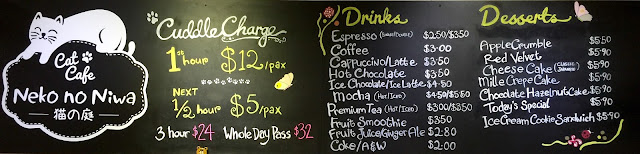
Menu

Neko No Niwa Cat Cafe Menu

Rates & Charges

1st hour — $12 
Every subsequent half hour — $5
3 hr Special Pass (3hrs) — $24
Whole Day Pass — $32 
*Free Hot Chocolate Beverage for students (please flash student ID)

Events
Hosting an event? Charges are specifically subjected to Date, Time and number of Hours, do drop them a call for an accurate quote!

Address      54A Boat Quay (2nd Level), (S)049843
Contact      6536 5319

Hours
Mon to Fri — 11am to 10pm (Closed on Tuesdays),
Sat, Sun & PH — 10am to 10pm


2. Meomi Cat Cafe


Meowmi Cat cafe logo and photo
via MeomiCatCafe
Cozy little nook located amongst the bustling life right beside Haji Lane, you may have noticed this nicely lit spot with Cats prowling within. Warm home to a group of 7 cats, of stunningly well-kept long and short hair breeds. If you haven’t gotten your fair share of feline love, Meomi Cat Cafe also carries a variety of kitty merchandise! From badges and mugs to adorable stickers, you can treat yourself to a little kitty goodness souvenir after a relaxing visit. 
  • Children must be above 4 years old, with adult supervision.

Menu

Meomi Cat cafe menu

Rates & Charges

1st hour — $13 
Every subsequent half hour — $5

Events

Hosting a private event? Charges are:
  • Weekdays — $200 every 1½ hours
  • Weekend — $250 every 1½ hours
*Rates only apply to venue rent
Maximum capacity — 15 pax


Address      668 North Bridge Road (S)188801
Contact      6296 0339

Hours
Mon to Sun (Daily) — 11am to 10pm


3. The Company of Cats *CLOSED*


The Company of Cats logo and photo
via TheCompanyofCats and SgAsia-City
This is one Cat Cafe that makes you feel homey and right in the heart of kitty activity. Everything about this cafe is cleverly themed and inter-linked, from its name, potty room for Cats (complete privacy)☺, to adorable Job Titles for each of the 11 Cats “working” here. The Company of Cats serves up a variety of food and beverages, feel free to have your tummies filled and hearts overloaded on undeniably adorable and exotic feline company.

*Update* 
Unfortunately the last date of operation for this cafe was 30 December 2017 with a heartfelt message on their Facebook page.

Cat Cafe closure
via TheCompanyofCats Facebook


4. The Cat Café


The Cat Cafe logo and photo
via TheCatCafe

Niftily located on a third floor, The Cat Café provides a puurrrfect “watch tower” home to 15 strays and rescued Cats. This Café is one of the largest and most spacious in Singapore, filled with toys, Cat condos and overhead structures, it is a smorgasbord of Kitty fun-time. It seems apparent that the Cats in the Cat Café are completely thrilled with their high view and lounging spot.

Grab a beverage or enjoy a nice piece of cake whilst chilling with cats, by the windows overlooking Bugis Street. 
  • All children must be aged 6 and above. 
  • Children under the age of 12 requires Adult supervision.

Menu

Cat Cafe Singapore menu

Rates

$15 per entry — Complimentary Soft Drink 


Events

Hosting a private event? Charges are:

Weekends — $500 every 2 hours
Weekdays — $350 every 2 hours

Maximum Capacity — 35 pax
*Rates only apply to venue rent

Address      241B Victoria Street (3rd Level, Above Burger King), (S) 188030
Contact      6338 6815

Hours
Mon — 3pm to 10pm
Tues to Sun & PH — 10am to 10pm


Why Visit A Cat Cafe?

Cat cafes are indeed a great option for avid Cat lovers who don’t own Cats due to certain constraints or personal reasons. Perhaps food and beverage isn’t one of their strongest traits (pretty decent stuff no less), just don’t go expecting Michelin Star rated food. But it warms our hearts knowing some these once abandoned Cats have found good homes and are undeniably well taken care of .

What you can be guaranteed of is a pleasurable, fuzzy and knowledgeable experience, sure to calm your senses— Psst, keep your eyes peeled for exotic breeds!
Cat Cafes In Singapore
via CatCurious
Hot Tip      Please note of the different age restrictions for the various Cafes, and no pets of your own are allowed within all the Cat Cafes listed above, Cafe owners would like to maintain the safety of their Cats and patrons alike.


**All of the above stated rates are up to date, but please do drop the cafes a call to reconfirm the pricing. Any changes in prices are completely subjected to the Cafe's rights.


An Inspiring Moment For All


For the safety of a cafe's own kitties, no. Also, it is advisable to keep your Cats indoors, given recent Cat-killing incidents, and Cats falling to their deaths. These Cat Cafes are perfect places to get some inspiration and tips of keeping your Cats perpetually entertained and safe indoors!

And from the looks of these Cat Cafes, can we just quote the wise words of Sheldon Cooper — “Meowow” :3


You might also be interested in:


Your Stories Can Be Heard Too

Have you visited these Cat Cafes yourself? Your voices are important to us and the Pets community! Our readers are encouraged to share their  Pet-related reviews of a place and its services, experiences, even lifestyle tips and tricks to better our Pets lives, on our platform, one paw at a time. Be a part of an educational and informative Pets community because at ThePetsDialogue, your voices could make a huge difference on a global scale.

Write to us at [email protected] today!

Our website is a work in progress, however, if you did find our articles interesting please do feel free to share! For more Pet care tips and other Pet-related articles, head to www.thepetsdialogue.com☺


Disclaimer

This article was written with informational purposes, as you know, we’d love to share our collective research and experiences as fellow Pet owners and lovers. It is not meant to alternate in any way as advice or diagnosis of Professionals.

ThePetsDialogue claims no credit for images posted on this article unless otherwise displayed/stated. All rights go to respective owners as mentioned. If you do not wish for your image(s) to appear here do drop us an e-mail and it will be removed promptly. If you do wish to use any of our original published information, you are welcome to contact us! 

Wednesday, October 17, 2018

Scottish Fold Cat Breed: Undeniably Adorable Cats From Scotland

Temperament, Care Tips, and History Of The Scottish Fold Cat


If you have always been charmed by the large doe-eyes of Puss-in-boots, know that you'd very well be smitten by this Cat breed. Coupled with guilt-ridden fold ears and all-rounded physiques, these Kitties bring a whole new level of adorable meowsomeness. 
Striped Tabby Silver Scottish Fold
via RokuRoku on Instagram
Do they have a personality to match their cute appearances? 


Where Did Scottish Fold Cats Come From?


The origin of this Cat breed can be traced back to a barn Cat from Perthshire, Scotland in 1961. Namely an all-white female Scottish Fold named Susie, that went on to produce two kittens— one of which was adopted by William Ross, a fellow farmer and Cat enthusiast whom named his kitten Snooks. Together with his friend Pat Turner (also a geneticist), the duo began a breeding program. 

Fun Fact #1      All Scottish Fold Cats share ancestry ties to Susie, the original Scottish Fold Cat!
Suzie, the first scottish fold
Susie, the 1st ever Scottish Fold - via EuroCatFancy
The Scottish Fold breed was first recognized in 1966 by GCCF (Governing Council of the Cat Fancy) of Great Britain. Registrations were then ceased in 1971, after the unfortunate discovery of limb and tail deformity, ear infections and deafness in some Scottish Fold Cats. Eventually, some were exported to America and crossbred with American Shorthair and British Shorthair Cats— the issue of deformity and ear infections are believed to have not surfaced since. The Scottish Fold Cat was then recognized by the CFA (Cat Fanciers’ Association) in 1977.


Scottish Fold Appearance


Size — This is a Medium sized breed with a rounded but robust appearance. Adult males can weigh from 4 to 6 kgs, and females from 3 to 4 kgs.

Features — In direct co-relation to their name, not only is this Cat from Scotland, the unmistakable folded ears are unique to its own breed. The rounded head, face, and large eyes may sometimes bear a resemblance to that of a Munchkin Cat. Tails are often long and densely packed with consistent hair thickness as their bodies.

Fun Fact #2      Original Scottish Folds have only one fold in their ears, but selective breeding has resulted in double or more folds, giving an almost flattened like appearance to those ears in modern Scottish Folds. 
Ginger Scottish Fold Cat
via Pinterest
Coat — This breed is available in both short and long coat variants— long coats are sometimes referred to as Highland Fold, Scottish Fold Longhair, or Longhair Fold. 

Colours — Known to come in a great variety of colours thats include Blue, White, Cream, Calico, Tabby, Silver, Gold, Black, Tortoise Shell and Chinchilla.

Fun Fact #3      It is possible for a Scottish Fold Cat to have normal, upright ears. A dominant gene is essential for folded ears to develop— Most kittens are all born with unfolded ears, folds may start developing only after 3 to 4 weeks!
Silver Tabby Scottish Fold Cat
via Pinterest


Grooming Requirements


Short Coat — Requires weekly brushing to rid loose hairs and speed up the process of shedding.

Long Coat — Increase weekly brushing to at least two or more times per week. 

The unique folded ears of a Scottish Fold is naturally more prone to wax build-up, frequently check their ears and clean them out with a Vet-approved ear cleaner and cotton ball(s). Other grooming needs includes nail trimming whenever necessary☺
Scotish Fold Cats with other Cats
via Yoko_1011 on Instagram
Avoid accidents if you are unsure of carrying out these tasks by approaching a professional Groomer for their services!


Temperament And Personality Of A Scottish Fold


Answering the initial query, you’d be pleased to know that the adorable outlook isn’t just for show—  the common disposition with this breed is that of a sweet-nature. The love for human affection puts them close-by most of the time. Highly adaptable in different environments, a Scottish Fold do great with children, crowds and even other Pets in the household. 
Roku the Scottish Fold standing like a meerkat
via RokuRoku on Instagram
Their sweetness has no end, with tiny soft voices and their natural disposition of laying on their backs, sitting upright with legs akimbo or front legs aloofly rested on their tummies. On a regular day, kitty-curiousity renders a Scottish Fold to stand up— like a Meerkat! These Cats love a good tease and challenging toys that tickle their intelligence.
Orange Tabby Scottish Fold Cat laying down
via Takikomigohan on Tumblr
They do not appreciate being neglected, an important factor you should seriously consider before obtaining one. In depth research and preparations are absolutely necessary to providing any Pet with proper care and love. With a good diet and a happy lifestyle, a Scottish Fold can live up to 14 years or more.


 You might also be interested in:


Your Stories Can Be Heard Too


Got an American Shorthair Cat of your own? We’d love to share your stories with the world! Your voices are important to us and the Pets community! Our readers are encouraged to share their Pet-related reviews of a place and its services, experiences, even lifestyle tips and tricks to better our Pets lives, on our platform, one paw at a time. Be a part of an educational and informative Pets community because at ThePetsDialogue, your voices could make a huge difference on a global scale.

Write to us at [email protected] today!

Our website is a work in progress, however, if you did find our articles interesting please do feel free to share! For more Pet care tips and other Pet-related articles, head to www.thepetsdialogue.com ☺


Disclaimer

This article was written with informational purposes, as you know, we’d love to share our collective research and experiences as fellow Pet owners and lovers. It is not meant to alternate in any way as advice or diagnosis of Professionals.

ThePetsDialogue claims no credit for images posted on this article unless otherwise displayed/stated. All rights go to respective owners as mentioned. If you do not wish for your image(s) to appear here do drop us an e-mail and it will be removed promptly. If you do wish to use any of our original published information, you are welcome to contact us!