Posts


Abyssinian Guinea Pig: The Guinea Pig With Blooming Hair
What image springs to mind when you think of a Guinea Pig? The small, classic, short-furred creature— the American Shorthair Guinea Pig. But this isn't the case for all breeds, more specifically for this post, the Abyssinian Guinea Pig.
 |
| Source |
The Abyssinian Guinea Pig
If you’ve always
considered having a Guinea Pig as a Pet but yearn for a slightly rarer-looking
one, the Abyssinian Guinea Pig might just be the Cavy for you. Contrary to
their name, they do not hail from Abyssinia (currently known as Ethiopia,
Africa), it is known that Guinea Pigs in general originated from South America.
The first appearance
of Abyssinian Guinea Pigs are still shrouded in mystery, but speculated to
possibly be as far back as 1200 to 1500 AD, Europe. It was during that time where
breeding of exotic looking Guinea Pigs took place, quickly gaining popularity. The name Abyssinian added a
luxurious, sell-able touch to this Guinea Pig breed's appearance. Today, they are also
fondly nicknamed, Abby for short.
 |
| Source |
Abyssinian Guinea Pig Appearance
The look of an
Abyssinian cavy is unmistakable, for has a coat like no other Cavy
breeds. Quite unlike the American Short Hair Guinea Pig of course, as the
Abyssinian has a distinct coat of long fur.
Coat — Made up of tufts and “whirls” or fur throughout their bodies, also known as rosettes. The only areas that are not covered by rosettes are their faces, and tummies. Their long coats are coarse, further aiding in maintaining the shape of the rosettes.
Colour — There is a wide range of possible coat colouration for an Abyssinian Guinea Pig. Such colours branch down from these categories:
Solid, Agouti, Brindle, Dalmation, Dutch, Roan, and Tortoiseshell.
Solid colours include: White, Orange, Brown, Black.
Agouti base colours include: Chocolate, Beige, Lilac.
Brindle, Dalmation, Dutch, Roan and Tortiseshell usually refers to patterned coloration of the Cavy’s coat, and could consist a mixture of different colours.
Coat — Made up of tufts and “whirls” or fur throughout their bodies, also known as rosettes. The only areas that are not covered by rosettes are their faces, and tummies. Their long coats are coarse, further aiding in maintaining the shape of the rosettes.
 |
Solid, Agouti, Brindle, Dalmation, Dutch, Roan, and Tortoiseshell.
Solid colours include: White, Orange, Brown, Black.
Agouti base colours include: Chocolate, Beige, Lilac.
Brindle, Dalmation, Dutch, Roan and Tortiseshell usually refers to patterned coloration of the Cavy’s coat, and could consist a mixture of different colours.
Fun Fact One might think of these rosettes as a messy outlook for this particular Cavy, but in actual fact— if you were lucky enough to own an Abyssinian cavy with symmetrical rosettes sitting on both right and left shoulders, each side of the hips, and two or four on its back, your Cavy might actually be a perfect show-standard!
How To Groom An Abyssinian Guinea Pig
Though the Abyssinian Cavy sports long fur which does indeed require care, it is not difficult or much more work as compared to a Guinea Pig with Short hair. Spare just a little more time brushing them gently with a soft bristled brush to avoid tangles, and bath them only if necessary. A monthly bath along with a Guinea Pig-friendly shampoo keeps their coat clean and healthy. Towel-dry thoroughly after.
Unlike other small animals like Rabbits, Hamsters or Chinchillas, Guinea Pigs do not require sand baths or pet-friendly disinfectant powder to keep clean. In fact, sand bath powder is known to cause serious respiratory problems for Guinea Pigs.
 |
| Source |
Guinea Pig Quick Care Tips
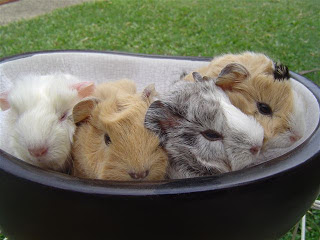
Housing — A good and comfy home for American Shorthair or any guinea pig would be soft and quality bedding. Some owners opt for fleece towels or even hay, just ensure cleanliness at all times. Avoid Pine and Cedar wood bedding as it may lead up to respiratory issues. Straw is also not advisable for absorbency purposes.
Ensure the living space/cage is of an appropriate size, large enough for your active Cavy to run and roam about. To prevent them from eating soiled hay, clean their living space regularly and provide fresh food and water!
Feeding — Good quality Hay is an absolute staple in a Guinea Pig's diet. Introduce a plate of hay for food with food pellets mixed in. Guinea Pigs require a ton of Fiber and Vitamin C, inclusion of fresh vegetables and occasional fruits treats are healthy. Recommendations for good quality Hay types are Timothy Hay, to encourage healthy teeth and a good digestive system.
Abyssinian Guinea Pig Personality
The Abyssinian Guinea
Pig is notorious for their playful and mischievous nature amongst all Cavy
breeds, yet endowed with intelligence that allows training to be a breeze. Simple commands such as approaching when called upon by name and returning to
their home proves to be no feat, according to owners.
Since they are also more active due to their
playful nature, it is important to allow your Abyssinian some exploring time
out of their cages every day. Abyssinian Guinea Pigs make great starter pets and have an average lifespan of 5 to 7 years with proper care. While they are friendly and sociable, precaution has to be taken still when handling them and introducing them to other house pets
 |
| Source |
Adopt An Abyssinian Guinea Pig
We would have never
imagined a rather exotic pet could be abandoned by anyone, but alas, we were
proven wrong when we saw a beautiful all white Abyssinian Guinea Pig up for adoption
at an Animal Shelter. We can’t stress enough on the importance of Pet ownership
really, if you have decided on a pet you want, ensure your commitment is firm as
well. Always seek for available options instead at local Animal Shelters before
purchasing one.
You might also be interested in:
Your Stories Can Be Heard Too
Do YOU have a story to share? Your voices are important to us and the Pets community! Our readers are encouraged to share their Pet-related reviews of a place and its services, experiences, even lifestyle tips and tricks to better our Pets lives, on our platform, one paw at a time. Be a part of an educational and informative Pets community because at ThePetsDialogue, your voices could make a huge difference on a global scale.
Write to us at [email protected] today!
Our website is a work in progress, however, if you did find our articles interesting please do feel free to share! For more Pet care tips and other Pet-related articles, head to www.thepetsdialogue.com ☺
Disclaimer
This article was written with informational purposes, as you know, we’d love to share our collective research and experiences as fellow Pet owners and lovers. It is not meant to alternate in any way as advice or diagnosis of Professionals.
ThePetsDialogue claims no credit for images posted on this article unless otherwise displayed/stated. All rights go to respective owners as mentioned. If you do not wish for your image(s) to appear here do drop us an e-mail and it will be removed promptly. If you do wish to use any of our original published information, you are welcome to contact us!