Showing posts with label Food. Show all posts

Wednesday, October 24, 2018

*UPDATED* Cat Cafes In Singapore: The Complete and Updated List For Cat Lovers!

Singapore's Cat Cafe Addresses, Menus, Rates and Sneak Peaks.


With the day-to-day stress at work here in Singapore, locals may find ourselves on a constant lookout for a unique haunt to ease our minds and take a load off work. For a small country, hitting the one and only Zoo is premediated from young. Where else could animal lovers go? 
two cats lazing on a book
via EgziPolat on Instagram
If you're completely guitly of loving Cats and even feeding strays, a little off-work or weekend visit to a Cat Cafe just might kill two birds with one stone. Sprouting in a few locales of sunny Singapore, Cafes of this nature provides feline lovers a chance to unwind after a hard day’s work amongst these lovely therapeutic kitties— some of which are also home to rescued Cats!

Hit them up at these places:


1. Cat Cafe Neko No Niwa

logo and photo of Cat Cafe
via Catcafe.com.sg
Opened in 2013, Neko No Niwa is the pioneer and first Cat Cafe to be established in Singapore. Adopting the crazy buzz of Cat Cafes in Japan, the cafe's name translates to mean Cat Garden in Japanese. This is a great place to gain first-hand experience with an array of unique Cat breeds.
Home to 13 recued kitties, from amazing cross breeds of Maine Coons, Siamese, Ragdolls and Persians. Have at a nice beverage or dessert and be in the company of beautiful Cat breeds. 
  • Children must be at least 7yrs of age
  • Adult supervision required for those aged between 7 to 14 years.

Menu
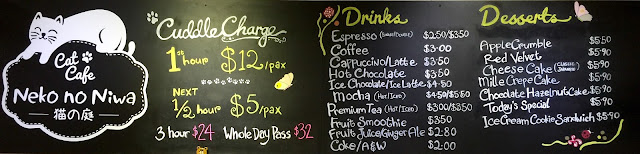
Neko No Niwa Cat Cafe Menu

Rates & Charges

1st hour — $12 
Every subsequent half hour — $5
3 hr Special Pass (3hrs) — $24
Whole Day Pass — $32 
*Free Hot Chocolate Beverage for students (please flash student ID)

Events
Hosting an event? Charges are specifically subjected to Date, Time and number of Hours, do drop them a call for an accurate quote!

Address      54A Boat Quay (2nd Level), (S)049843
Contact      6536 5319

Hours
Mon to Fri — 11am to 10pm (Closed on Tuesdays),
Sat, Sun & PH — 10am to 10pm


2. Meomi Cat Cafe


Meowmi Cat cafe logo and photo
via MeomiCatCafe
Cozy little nook located amongst the bustling life right beside Haji Lane, you may have noticed this nicely lit spot with Cats prowling within. Warm home to a group of 7 cats, of stunningly well-kept long and short hair breeds. If you haven’t gotten your fair share of feline love, Meomi Cat Cafe also carries a variety of kitty merchandise! From badges and mugs to adorable stickers, you can treat yourself to a little kitty goodness souvenir after a relaxing visit. 
  • Children must be above 4 years old, with adult supervision.

Menu

Meomi Cat cafe menu

Rates & Charges

1st hour — $13 
Every subsequent half hour — $5

Events

Hosting a private event? Charges are:
  • Weekdays — $200 every 1½ hours
  • Weekend — $250 every 1½ hours
*Rates only apply to venue rent
Maximum capacity — 15 pax


Address      668 North Bridge Road (S)188801
Contact      6296 0339

Hours
Mon to Sun (Daily) — 11am to 10pm


3. The Company of Cats *CLOSED*


The Company of Cats logo and photo
via TheCompanyofCats and SgAsia-City
This is one Cat Cafe that makes you feel homey and right in the heart of kitty activity. Everything about this cafe is cleverly themed and inter-linked, from its name, potty room for Cats (complete privacy)☺, to adorable Job Titles for each of the 11 Cats “working” here. The Company of Cats serves up a variety of food and beverages, feel free to have your tummies filled and hearts overloaded on undeniably adorable and exotic feline company.

*Update* 
Unfortunately the last date of operation for this cafe was 30 December 2017 with a heartfelt message on their Facebook page.

Cat Cafe closure
via TheCompanyofCats Facebook


4. The Cat Café


The Cat Cafe logo and photo
via TheCatCafe

Niftily located on a third floor, The Cat Café provides a puurrrfect “watch tower” home to 15 strays and rescued Cats. This Café is one of the largest and most spacious in Singapore, filled with toys, Cat condos and overhead structures, it is a smorgasbord of Kitty fun-time. It seems apparent that the Cats in the Cat Café are completely thrilled with their high view and lounging spot.

Grab a beverage or enjoy a nice piece of cake whilst chilling with cats, by the windows overlooking Bugis Street. 
  • All children must be aged 6 and above. 
  • Children under the age of 12 requires Adult supervision.

Menu

Cat Cafe Singapore menu

Rates

$15 per entry — Complimentary Soft Drink 


Events

Hosting a private event? Charges are:

Weekends — $500 every 2 hours
Weekdays — $350 every 2 hours

Maximum Capacity — 35 pax
*Rates only apply to venue rent

Address      241B Victoria Street (3rd Level, Above Burger King), (S) 188030
Contact      6338 6815

Hours
Mon — 3pm to 10pm
Tues to Sun & PH — 10am to 10pm


Why Visit A Cat Cafe?

Cat cafes are indeed a great option for avid Cat lovers who don’t own Cats due to certain constraints or personal reasons. Perhaps food and beverage isn’t one of their strongest traits (pretty decent stuff no less), just don’t go expecting Michelin Star rated food. But it warms our hearts knowing some these once abandoned Cats have found good homes and are undeniably well taken care of .

What you can be guaranteed of is a pleasurable, fuzzy and knowledgeable experience, sure to calm your senses— Psst, keep your eyes peeled for exotic breeds!
Cat Cafes In Singapore
via CatCurious
Hot Tip      Please note of the different age restrictions for the various Cafes, and no pets of your own are allowed within all the Cat Cafes listed above, Cafe owners would like to maintain the safety of their Cats and patrons alike.


**All of the above stated rates are up to date, but please do drop the cafes a call to reconfirm the pricing. Any changes in prices are completely subjected to the Cafe's rights.


An Inspiring Moment For All


For the safety of a cafe's own kitties, no. Also, it is advisable to keep your Cats indoors, given recent Cat-killing incidents, and Cats falling to their deaths. These Cat Cafes are perfect places to get some inspiration and tips of keeping your Cats perpetually entertained and safe indoors!

And from the looks of these Cat Cafes, can we just quote the wise words of Sheldon Cooper — “Meowow” :3


You might also be interested in:


Your Stories Can Be Heard Too

Have you visited these Cat Cafes yourself? Your voices are important to us and the Pets community! Our readers are encouraged to share their  Pet-related reviews of a place and its services, experiences, even lifestyle tips and tricks to better our Pets lives, on our platform, one paw at a time. Be a part of an educational and informative Pets community because at ThePetsDialogue, your voices could make a huge difference on a global scale.

Write to us at [email protected] today!

Our website is a work in progress, however, if you did find our articles interesting please do feel free to share! For more Pet care tips and other Pet-related articles, head to www.thepetsdialogue.com☺


Disclaimer

This article was written with informational purposes, as you know, we’d love to share our collective research and experiences as fellow Pet owners and lovers. It is not meant to alternate in any way as advice or diagnosis of Professionals.

ThePetsDialogue claims no credit for images posted on this article unless otherwise displayed/stated. All rights go to respective owners as mentioned. If you do not wish for your image(s) to appear here do drop us an e-mail and it will be removed promptly. If you do wish to use any of our original published information, you are welcome to contact us! 

Tuesday, May 15, 2018

Can My Guinea Pig Eat This?: Guinea Pig Friendly Vegetables and Fruits

Can My Guinea Pig Eat This?: Guinea Pig Friendly Vegetables and Fruits


What vegetables and fruits are safe for Guinea Pigs? If you didn't know by now, not all greens and fruits are Guinea Pig-friendly. An appropriate diet for your Cavy friends can be as tricky as a Rabbit’s for a first-time owner— largely made up of good quality Hay, food pellets, fresh vegetables and occasionally, a delightfully fruity treat.
Source

Note


The recommended amount of vegetables to be fed is 200 to 240ml (approximately 1 Cup)— this is by no means a daily must. When introducing new foods to your Guinea Pig, always introduce in very small amounts with gradual increase for each feed, so as to avoid stomach upsets. All Guinea Pigs are different, there may be restrictions or certain dietary needs  one might have to adhere to. Consult your trusted Veterinarian for a specific diet-plan if need be.

What can you feed your Guinea Pigs?

Let us present a simple list below, to give you a good head start on the safe and not so safe. You'd be elated to also know that these are mostly readily available at a local supermarket or a normal market!


Guinea Pig Safe Vegetables


Certain vegetables and herbs are a great source of nutrients for your Guinea Pig,  and even so, moderation is strongly advised for some vegetables— too much of which may cause bloating and gas.

Radish  |  Alfalfa  |  *Cabbage  |  Carrots  |  Cilantro  |  Basil  |  Green, Red, Yellow Bell Peppers  |  Lettuce  |  Wheat Grass  |  Cucumber   |  Chicory  |  Mint  |  Peppermint Leaves  |  Parsnip  |  Celery  |

*Occasional — Beets  |  Corn  |  Broccoli  |  Brussels Sprouts  |  Watercress  |  Parsley  |  Snow Peas (including the flat pods)

 * Include these items only once or twice a week, overfeeding may cause bloating and gas.
Safe foods for Guinea Pigs


Guinea Pig Safe Fruits


Similarly, the occasional fruit treat can also provide a Guinea Pig with beneficial nutrients. However, a treat is not meant to be as frequent nor as much as compared to vegetables. Certain fruits such as Bananas are to be fed with extreme moderation— due to high sugar content and likelihood of constipation.

Tomato  |  Melon  |  Apple  |  Orange  |  Peach  |  Papaya  |  Pear  |  Raspberries  |  Strawberries   |  Blueberries  |  Pineapple  |  Cherries  |  Grapes

Occasional — Blackberries  |  Cranberries  |  Mango  |  Rock Melon  |  Watermelon 

*Banana

* High in sugar, feed with extreme moderation (i.e. once a month)
What can Guinea Pigs eat


A Guinea Pig's Diet


There you have it, an easy guide to safe and unsafe foods for Guinea Pigs. Be sure to introduce new food items in small portions (preferably a small piece), and slowly increasing. A sudden change in diet can cause a sensitive Guinea Pig’s tummy to be upset. The main part of their diet should still consist of fresh, good quality Hay every day— Timothy Hay is best for adults, whereas Alfafa should be mixed in for young Guinea Pigs.
A fresh change of water and fruits or vegetables is equally as important, to maintain good hygiene and a safe living environment for your Cavies. 

You might also be interested in:


Your Stories Can Be Heard Too


Share your Guinea Pig tips with us! We’d love to share them with the world! Your voices are important to us and the Pets community. Our readers are encouraged to share their  Pet-related reviews of a place and its services, experiences, even lifestyle tips and tricks to better our Pets lives, on our platform, one paw at a time. Be a part of an educational and informative Pets community because at ThePetsDialogue, your voices could make a huge difference on a global scale.

Write to us at [email protected] today!

Our website is a work in progress, however, if you did find our articles interesting please do feel free to share! For more Pet care tips and other Pet-related articles, head to www.thepetsdialogue.com ☺


Disclaimer


This article was written with informational purposes, as you know, we’d love to share our collective research and experiences as fellow Pet owners and lovers. It is not meant to alternate in any way as advice or diagnosis of Professionals. 


ThePetsDialogue claims no credit for images posted on this article unless otherwise displayed/stated. All rights go to respective owners as mentioned. If you do not wish for your image(s) to appear here do drop us an e-mail and it will be removed promptly. If you do wish to use any of our original published information, you are welcome to contact us!

Wednesday, April 11, 2018

Can Rabbits Eat These?: Rabbit-Friendly Vegetables And Fruits

Can Rabbits Eat These?: Rabbit-Friendly Vegetables And Fruits


Good-quality Hay is a Rabbit’s best friend, it is and should be their main source of food intake (aside from daily fill of food pellets) after all. It comes to no surprise that vegetables play a huge role in a Rabbit’s diet too!—Some veggies are good, and others, not so. Special care and requirements can get a little tricky when planning out your Rabbit’s diet or introducing something new to your Rabbits.
What vegetables can i feed my Rabbit?
Source
Many of us might not have the luxury of specially heading to the market to grab greens for our bunnies, but the least any Rabbit owner is able to do is consider the following list of commonly available vegetables and fruits the next time you are doing your grocery shopping J

So which vegetables and fruits can we feed our Rabbits?


Note


Every Rabbit and Pet is different, exercise precaution and not get too overly excited, a limit you’ve set yourself to feed i.e. 1 small piece of fruit should stay at 1 small piece— try as hard as you can not to buy into their adorable demeanor! Approach a trusted Veterinarian or Pet Nutritionist for an accurate guideline for dietary specifics as required for your own Rabbit. Being extra cautious is never harmful!


Rabbit Friendly Vegetables


This is a simple guide of go-to-vegetables that are easily obtainable at local markets and supermarkets. For an inexperienced or budding Rabbit owner, it may be inevitable to deem all vegetables Rabbit friendly at first— don’t be embarrassed about it! Be proud that you’re making the effort to do your research at least, and now all you gotta do is stick to it!

1. Asparagus

2. Broccoli — Inclusive of Leaves, and Purple Varieties

3. Pumpkin

4. Baby Corn — Not Full Size Ones

5. Brussel Sprouts

6. Cabbage — Introduce In Very Small Amounts

7. Carrots — High In Sugar, Feed with moderation

8. Cauliflower — Including leaves

9. Rocket (Arugula)

10. Celery — Including leaves

11. Watercress

12. Cucumber

13. Green bean

14. Snow Peas — Flat Peas In Pods

15. Capsicum — Bell Peppers: Red, Green and Yellow

16. Spinach — Occasional


Rabbit Friendly Fruits


It is absolutely important to know that fruits should not be in any way a main source of food for your Rabbits, due to their high sugar content. However, they can be given or used as occasional treat, preferably once or twice a week. Again, in very small amounts and with moderation.
Rabbit eating raspberry
1. Strawberries

2. Raspberries

3. Apple

4. Melon (Honey Dew, Watermelon, Rock Melon)

5. Blackberries

6. Pineapple

7. Blueberries

8. Peach

9. Papaya

10. Pear

11. Banana (high in sugar, feed in very small amounts)

We are not sure if there are any types of Pets out there that do not like fruits— even Cats with their inability to taste sweetness are known to be huge fans of melons! The sight of your Pet(s) enjoying a treat is beyond satisfaction. 
Rabbit with cute eyes
Source
All greens and fruits should be fed in moderation and strict monitoring, usually, a safe method would be to introduce these food items to your Rabbits in small amounts. Bear in mind that a sudden change of diet can cause tummy upsets, and certain vegetables like cabbage is known to produce too much gas. If your Rabbit has diarrhoea or a bad reaction to any food source it would be advisable to stop feeding them those vegetables and consult a Veterinarian immediately to seek advice for an alternative nutritional supplement necessary for your Rabbits!


You might also be interested in:


Your Stories Can Be Heard Too


Got a tip of your own? Your voices are important to us and the Pets community! Our readers are encouraged to share their  Pet-related reviews of a place and its services, experiences, even lifestyle tips and tricks to better our Pets lives, on our platform, one paw at a time. Be a part of an educational and informative Pets community because at ThePetsDialogue, your voices could make a huge difference on a global scale.

Write to us at [email protected] today!

Our website is a work in progress, however, if you did find our articles interesting please do feel free to share! For more Pet care tips and other Pet-related articles, head to www.thepetsdialogue.com ☺


Disclaimer


This article was written with informational purposes, as you know, we’d love to share our collective research and experiences as fellow Pet owners and lovers. It is not meant to alternate in any way as advice or diagnosis of Professionals.

ThePetsDialogue claims no credit for images posted on this article unless otherwise displayed/stated. All rights go to respective owners as mentioned. If you do not wish for your image(s) to appear here do drop us an e-mail and it will be removed promptly. If you do wish to use any of our original published information, you are welcome to contact us!
Friday, March 30, 2018

Can Cats Eat These Foods?: 7 Cat-Friendly Foods With Nutritional Benefits!

Can Cats Eat These Foods?: 7 Cat-Friendly Foods With Nutritional Benefits! 


Like Dogs, our feline friends share the same behaviour of preferring what is on their owner’s dinner plate. It is good to know that there are some foods that could totally benefit your cat and are safe to share. But before you fall for their puss-in-boots looks, take some time to go through this list we have compiled for your convenience J
Cat Friendly Human foods
Source


Note


Are you excited to piece together some ingredients and create a lovely snack for your Cat? Do not forget to take extra caution with some ingredients and find out if your feline friends are allergic to them. Moderate small portions of servings— never overfeed your Cats with excessive ingredients. Every Cat is different, consult your Veterinarian for advice on what is safe for your Cat.


The Top 7 Cat Friendly Human Foods


1. Meats — Cats are naturally and instinctively carnivorous, and evidently from commercial kibble or canned food, meat is one of felines' favourites. Treat your kitty to some fresh, boiled, unseasoned meats— with the choice of Chicken, Beef or Turkey, and ensure that they are boneless. Meats are an ultimate source of protein for Cats.
Try out some easy Cat treat recipes here!


2. Fish — There is not a Cat that does not love fish, and like meats they too, play a huge part in a Cat’s diet. Fish meat is rich with Omega 3 Fatty Acids. It is advised to not serve your Cats too much raw fish as they may contain traces of harmful bacteria can lead up to food poisoning (i.e. Salmonella). Raw fish also contain an enzyme that destroys Thiamine— an essential Vitamin B for your Cats.
cat and fishes
Are you a RAW-feeder? Here's a handy list of where you can find freshly prepared raw meals for your feline companions with a wild appetite:

Raw Feeding For Dogs And Cats: The List Of Homemade Raw Food Merchants In Singapore


3. Eggs — Believe it or not, Hard-boiled and Plain Scrambled Eggs are a favourite snack of many felines, and they are a great source of protein and Vitamin B. However, some cats may have allergic reactions for eggs, so do test it out with a tiny amount and watch your kitty’s behaviour before serving up a proper portion. Make sure your eggs are fully cooked before serving!


4. Whole Grains — Though purely optional, another super source of protein are certain whole grains such as Polenta, Brown Rice, Barley, Millet, and Cous Cous. Make sure the grains are properly cooked through before serving to prevent your Cat from being unable to digest the grains properly!
whole grains
** This option may do better for Cats that have been brought up with rice or grains at a young age. Monitor their intakes, to avoid incurring excess weight from too much carbohydrates.


5. Cheese / Dairy — Great for the non lactose-intolerant felines (Vets and experts have discovered that Cats in their adulthood are more likely to develop this). A small test can be carried out just to be sure— If your Cats are not having diarrhea from a very small amount, you may continue to include tiny portions of non-flavoured, Low Fat Cheese, Plain Yoghurt, and Milk into their diets. These are yet another good source of protein!


6. Vegetables — While Cats do not require greens essentially, you may chance upon them chomping on house-hold plants, or even come across Cat owners whom grow Wheat Grass for their Cats. From time to time, our feline friends lack some needed enzymes for breaking down food in their digestive systems— chomping on greens gives them a roughage of fiber they require.
Can Cats Eat Vegetables?
Source
Keep them away from house plants that may contain harmful toxic chemicals, instead, try an occasional tiny snack of boiled Broccoli, Asparagus or Green Beans. Thoroughly wash the vegetables before boiling and/or serving.


7. Fruits — Just in case you were wondering, Cats lack the ability to taste sweetness. However, a few owners have reported at how their Kitties have gone crazy over Melons. Fruits could be a great and helpful alternative for fiber if your Cats show no interest in Vegetables! Watermelon and Honey Dew are both great choices— serve in small portions and ensure all seeds are removed.
What Can I feed my cat
Source

You might also be interested in:


Your Stories Can Be Heard Too


Got more to add to this list? Your voices are important to us and the Pets community! Our readers are encouraged to share their  Pet-related reviews of a place and its services, experiences, even lifestyle tips and tricks to better our Pets lives, on our platform, one paw at a time. Be a part of an educational and informative Pets community because at ThePetsDialogue, your voices could make a huge difference on a global scale.
Source 
Write to us at [email protected] today!

Our website is a work in progress, however, if you did find our articles interesting please do feel free to share! For more Pet care tips and other Pet-related articles, head to www.thepetsdialogue.com ☺


Disclaimer


This article was written with informational purposes, as you know, we’d love to share our collective research and experiences as fellow Pet owners and lovers. It is not meant to alternate in any way as advice or diagnosis of Professionals.

ThePetsDialogue claims no credit for images posted on this article unless otherwise displayed/stated. All rights go to respective owners as mentioned. If you do not wish for your image(s) to appear here do drop us an e-mail and it will be removed promptly. If you do wish to use any of our original published information, you are welcome to contact us! 

Friday, March 16, 2018

American Shorthair Guinea Pig: The Oldest Breed Of Guinea Pigs

American Shorthair Guinea Pig: The Oldest Breed Of Guinea Pigs


Guinea Pigs have been around for a much longer time than we'd imagine, and also found their way into the hearts of many Cavy-enthusiats as a beloved Pet. The American Shorthair is the most common and oldest breed amongst the cavy community. Also known as English Guinea Pig in some other parts of the world— Not a Rabbit, nor a Hamster, Guinea Pigs are unique to their own!
Guinea Pig Breeds
Source
Fun fact      Guinea Pigs are called Cavy for short, derived from their species in the rodent family, Caviidae, and genus family Cavia. Another common nickname is also Piggies, but they aren't related to pigs nor from Guinea.


American Shorthair Guinea Pig


At the mention of Guinea Pig(s), it's no surprise if an image of an American Shorthair pops into one's mind. Being the first breed to be introduced as domestic Pets, the American Shorthair is widely stereotyped as a classic type for Guinea Pigs. Originating from South America as early as 5000 BC, the American Shothairs are descendants of the Tschudi Guinea Pig.
Tschudi cavy the ancestor of guinea pigs
Tschudi Guinea Pig
The human race began rearing them in the 1500’s, creating other breeds we see today. Often utilized as test subjects in laboratories, spontaneity in genetic mutations also played a part in creating a few breed variables. Guinea Pigs were introduced to America by European traders, and were named American Shorthair by the ACBA (American Cavy Breeders Association) in the 1960’s.

Appearance Of The American Shorthair


Coat — American Shorthair Guinea Pigs sport smooth short coats, with straight hairs that require little to minimal grooming.

Form — They have a round body with broad shoulders, and hind legs should be tucked nicely under their bodies. Front legs should be slightly visible from the front view. They should have an average weight of 1 kilogram when fully grown. Ears are smooth to the touch, and sit at both sides of their head like tiny flaps.
american short hair guinea pigs in different colours
Source
Colour — American Shorthairs are available in a variety of colours. Varying from solid colours like Black, Cream, Red, White, Beige, Chocolate, Lilac, Golden Agouti, Silver, Dalmatian, Himalayan, Tortoise Shell, to patterns and patches as well. 


How To Groom An American Shorthair Guinea Pig


Unlike other small animals like Rabbits, Hamsters or Chinchillas, Guinea Pigs do not keep clean with sand baths or Rabbit-friendly disinfectant powder. It is permissible to bath your Guinea Pig in water. In fact, sand bath powder is known to cause serious respiratory problems for your Piggy.
An American Shorthair Piggy's sleek, straight and short coat does not require extensive maintenance. On top of that, they are great self-groomers too. A monthly bath along with a Guinea Pig-friendly shampoo keeps their coat clean and healthy. Towel-dry thoroughly after.
guinea pig taking a bath
Source
 As akin to their cousins of the rodent species, avoid bathing them too often— their skin can be rather sensitive to too frequent bathing, leading to dry skin. Finish up with soft-bristled brushing from time to time, teeth and nail checks, your Guinea Pig would be brand spankin’ new. If you are unsure how to perform these tasks, approach a trusted Groomer and Veterinarian to have your Cavy handled professionally!


Guinea Pig Quick Care Tips


Housing — A good and comfy home for American Shorthair or any guinea pig would be soft and quality bedding. Some owners opt for fleece towels or even hay, just ensure cleanliness at all times. Avoid Pine and Cedar wood bedding as it may lead up to respiratory issues. Straw is also not advisable for absorbency purposes.

Ensure the living space/cage is of an appropriate size, large enough for your active Cavy to run and roam about. To prevent them from eating soiled hay, clean their living space regularly and provide fresh food and water!
American short hair guinea pig in grass
Feeding — Good quality Hay is an absolute staple in a Guinea Pig's diet. Introduce a plate of hay for food with food pellets mixed in. Guinea Pigs require a ton of Fiber and Vitamin C, inclusion of fresh vegetables and occasional fruits treats are healthy. Recommendations for good quality Hay types are Timothy Hay, to encourage healthy teeth and a good digestive system.


 Personality Of An American Shorthair Guinea Pig


Known to be the calmest of all Guinea Pig breeds, American Shorthairs love getting patted by their human companions. Having a sweet and docile nature, they are also reported to greet owners when you're back home from work— letting out a Wheeekk! of excitement. 


guinea pig standing next to owner
Being expressive and non-aggressive, American Shorthairs rarely bites, only on the off-set chance they mistake your finger for food. Their friendly personalities and easy maintenance makes them one of the best Cavy choice for a starter Pet! With proper care, love and attention, the average lifespan of a Guinea Pig is 5 to 7 years.


Related Articles:


Your Stories Can Be Heard Too


Do YOU have a story to share? Your voices are important to us and the Pets community! Our readers are encouraged to share their Pet-related reviews of a place and its services, experiences, even lifestyle tips and tricks to better our Pets lives, on our platform, one paw at a time. Be a part of an educational and informative Pets community because at ThePetsDialogue, your voices could make a huge difference on a global scale.

Write to us at [email protected] today!

Our website is a work in progress, however, if you did find our articles interesting please do feel free to share! For more Pet care tips and other Pet-related articles, head to www.thepetsdialogue.com ☺


Disclaimer


This article was written with informational purposes, as you know, we’d love to share our collective research and experiences as fellow Pet owners and lovers. It is not meant to alternate in any way as advice or diagnosis of Professionals.

ThePetsDialogue claims no credit for images posted on this article unless otherwise displayed/stated. All rights go to respective owners as mentioned. If you do not wish for your image(s) to appear here do drop us an e-mail and it will be removed promptly. If you do wish to use any of our original published information, you are welcome to contact us!