Showing posts with label Statistics. Show all posts

Thursday, April 19, 2018

Golden Retrievers: The Gentle Dog Breed With A Coat and Heart Of Gold

Intelligent, Hardworking, Gentle, and Loving All Into One!


The kind and gentle face of a Golden Retriever goes way beyond physical appearances. These Dogs are able to win over just about any heart of a Dog lover. While they can be commonly sighted and widely owned, don't you wonder why and how canine lovers seem to have nothing bad to say about this breed?
Golden Retriever Dog Breed
Source


The Golden Retriever


The first Golden Retrievers were bred in Scotland during the mid-19th century, when Wild Fowl Hunting (the sport of hunting game birds) was popular amongst the rich and noble. They were then bred with the best Water Spaniels— resulting in the breed we know of today. 

Fun Fact #1      The initial Retriever breed did not possess skills to perform the tasks of fetching downed birds from the allocated hunting grounds of both land and water.

The belief of breeding Golden Retrievers involving Russian Trackers was dismissed by precise records of its breeder, Dudley Majoribanks, 1st Baron of Tweedmouth. Gun improvements in the 1800's meant only one thing, the downed game (hunted animals) were further and tougher to retrieve.
Golden retriever fetching fowl
Source
Majoribanks began his conquest of breeding the best ideal hunting retriever breed that were not only active and robust, but also came eqquipped with the ability to perform soft retrievals that did not damage the birds. Golden Retrievers were accepted by The Kennel Club of England in 1903—  first exhibited in 1908 and recognized as an official breed in 1911. 

The first Golden Retriever to be recognised by AKC in America only happened 14 years later, in 1925. Archibald Majoribanks brought his Golden Retriever named Lady to Canada in 1881, gaining recognition only in 1927. 
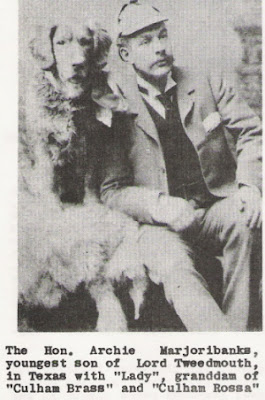
Archibald Majoribanks
Source


Appearance: Three Types Of Golden Retrievers


Today, breeding for different registry standards has resulted in 3 sub-types of Golden Retrievers, and this is how you can roughly tell them apart.


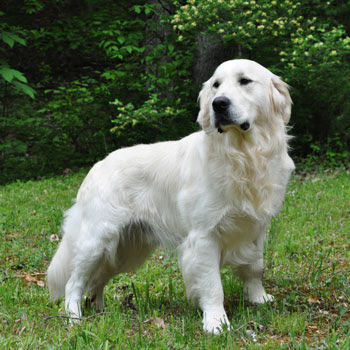
1. British Golden Retrievers — First of its breed with broader skulls and a more muscular body, the British sub-type is meant to be a great sport dog. They generally have a lighter coloured coat and a very chiseled muzzle with dark round eyes. The average height from the withers (tallest point in between shoulder blades to fore legs) of an adult Male is 56 to 61 cm, and Females 51 to 56 cm.

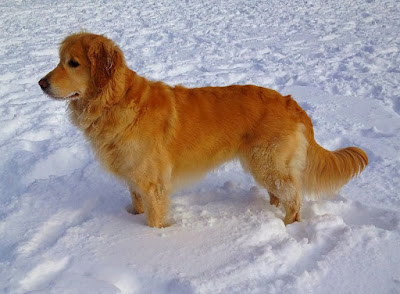
2. American Golden Retriever — Darker coat of Gold and a less muscular body. A common standard in many countries, as the requirements are very specific. The American sub-type has slightly slanted, triangular eyes as compared to their British counterparts. Adult Males stand at 58 to 61 cm, Females at 55 to 27 cm.

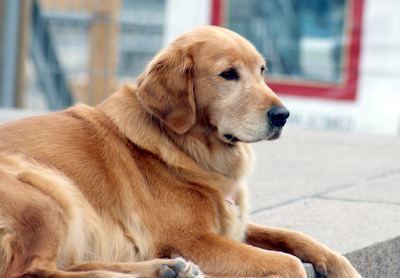
3. Canadian Golden Retriever — Tallest amongst all three types, adult Males stand at 58 to 61 cm, Females at 55 to 57 cm. The Canadian sub-type has thinner coats as compared to American and British sub-types of Golden Retrievers.


Grooming A Golden Retriever


Coat — As their names states, Golden Retrievers are well, Golden ☺. This Gold hue ranges from a shade of Light to Dark. General feathering of hair is light at the back of forelegs. Their necks, bottom of tail, and back of hind legs have heavier feathering.

Fun Fact #2      Top coats are water resistant and has a slight wave to it, while their soft undercoats serve dual purposes— to keep them cool and airy in hot weathers, and warm in cold climates.
Golden Retriever Dog breed info
Source
All types of Golden Retrievers shed lightly all year round. Regular combing and a bath once every month or two keeps their coats clean and healthy. Brushing prevents excessive matting and knotting or their coats. Practice good oral hygiene and make sure their ears are cleaned— with a Vet-approved toothpaste and cleanser respectively. Nails should be clipped before they start to clack on the ground. 

If you are unsure how to perform these tasks, approach a trusted Groomer or Veterinarian for professional service!


Personality Of A Golden Retriever


A gentle giant is what we can observe when we have close encounters a Goldie. Is it still to anyone's surprise that they are indeed loved by the masses?☺ Coupled with high intelligence and a workaholic mind, Golden Retrievers excel in learning tricks, including training for obedience and patience. On top of that, they are also known to be xtremely sociable and great with children and other pets— thus making them an excellent choice for a house Pet.
Golden retrievers and other pets
Source
Though friendly, Golden Retrievers are able to alert their owners when there are intruders or signs of danger. This however, does not imply that they are aggressive. Owners are advised not to overwork their Goldies, for it is easy to take their eagerness to please and hardworking attitude for granted. it’s no wonder they are one of the top choices for Guide Dogs, and Search and Rescue Dogs! With lots of love and proper care, the average lifespan of a Golden Retriever is 12 years.

Fun Fact #3       Any display or signs of aggression by a Golden Retriever during Dog Show immediately disqualifies them! 


You might also be interested in:


Your Stories Can Be Heard Too


Have YOU tried any of these services? Your voices are important to us and the Pets community! Our readers are encouraged to share their Pet-related reviews of a place and its services, experiences, even lifestyle tips and tricks to better our Pets lives, on our platform, one paw at a time. Be a part of an educational and informative Pets community because at ThePetsDialogue, your voices could make a huge difference on a global scale.


Write to us at [email protected] today!


Our website is a work in progress, however, if you did find our articles interesting please do feel free to share! For more Pet care tips and other Pet-related articles, head to www.thepetsdialogue.com ☺


Disclaimer


This article was written with informational purposes, as you know, we’d love to share our collective research and experiences as fellow Pet owners and lovers. It is not meant to alternate in any way as advice or diagnosis of Professionals.


ThePetsDialogue claims no credit for images posted on this article unless otherwise displayed/stated. All rights go to respective owners as mentioned. If you do not wish for your image(s) to appear here do drop us an e-mail and it will be removed promptly. If you do wish to use any of our original published information, you are welcome to contact us!

Thursday, February 22, 2018

The Toy Poodle: Where Did These Popular Dogs Come From?

The Toy Poodle: Where Did These Popular Dogs Come From?


Curly coats, round eyes and seen mostly skipping or trotting with high energy, these are just some of the characteristics we can describe of a Toy Poodle. One thing's for sure though, they aren't a rare sight. In fact, it almost seems impossible to get by a month without running into a Toy Poodle. 
Toy Poodle breed origins
Source
This has stirred our curiosity immensely— Why Is The Toy Poodle so popular?


Poodle Dog Sizes


There are a total of 3 sizes available to a Poodle; from largest to smallest— Standard, Miniature and Toy. However, unlike the Schnauzer Dog breeds, the different sizes of Poodles aren't considered individual breeds. Instead, the difference in sizes are referred to as just size variations.


Origins — Toy Poodles were originally bred from Standard Poodles. Though the origins of the Standard Poodle is still shrouded in mystery, records can be traced centuries back to Europe, namely Germany and France. As favoured pets of hunters, Standard Poodles ancestors accompanied their masters on hunting trips, and were renowned for their abilities to hunt ducks and fetch them from waters.
Standard Poodle size
Standard Poodles


Royal Choice — The popularity of Standard Poodles inclined massively when the French Aristocrats began to recognize this breed for their lovable personalities. The late King Louis XVI of France had a Toy Poodle (Filou), he also named the Poodle as France’s National Dog. Even the late Queen Anne of England fell in love with these pooches. 
King Louis XVI France
Source
Fun Fact      The Toy Poodle has many names: Dwarf Poodle, French Poodle, and Teddy Poodle. But the original name was derived from German Huntsmen, whom referred to them as Pudel — translating to mean Splash or Puddle, in co-relation to one of their many abilities in hunting across waters.


Appearance Of The Poodle


The misconception of the Poodle breed to be sissy-looking cannot be more inaccurate. The poodle had long been a stylish, trendy dog for women and many celebrities, like Elizabeth Taylor.  During the 19th century, Toy Poodles began to gain recognition by the AKC (American Kennel Club), becoming a regular breed to compete in shows. 

Here's why we beg to differ...

Standardized Look — It's uncountable how many times we’ve seen Poodles strutting with their noses held high in cartoons, usually accompanied by their snooty Lady owners. Little did we know, that German Hunters originally created the Standard look, for the convenience and ease of the Poodles swimming in water! Minimal hair enhances mobility in water— Hair was only kept around certain areas for insulation.
Clipping styles for Poodles
Clipping style: Continental

Colours — The Toy Poodle today has developed into a variety of available colours: Brown, Black, Grey, White, Cream, Apricot, and Red. Their eyes are usually brown, and may varying in hues of brown depending on hair colour. 


Grooming Requirements Of A Toy Poodle


With only one layer of hair, Toy Poodles are generally a breeze to groom. Thick wiry curls make shaping simple, and even pretty water resistant! However, long hair will eventually curl into cords, ensure regular clipping to avoid matting issues— Interestingly enough, some owners actually prefer the cords.
Teddy Poodle cut
Source
Brushing is said to be much easier as compared to other long-haired dog breeds. Don’t forget the regular baths, clipping of nails when necessary, and also dental care. If you are unsure how to perform these tasks, approach your trusted Groomer or Veterinarian ☺


Behaviour Of Toy Poodles


As mentioned earlier, Toy Poodles are highly intelligent, and though they meant to be kept indoors, they're great watch dogs due to their alertness, and natural affection towards owners and family. Outdoor activities are required for a little exercise, expect your Toy Poodle to be following you around the house, laying next to you, and yearning for some attention. Toy Poodles do not take being neglected lightly.
Toy Poodle personality
Source
Entertainment is possible with toys and treats, and also simple games like hide-and-seek. Their personalities should always be bubbly and springy, so it could be a challenge having them around young toddlers. Obedience and faithfulness can be achieved with proper training., as Toy Poodles are highly intelligent. Don't be surprised if owners sing praises of how well behaved their Poodles are, we can understand why!


What Made The Toy Poodle A Popular Choice


To top a Toy Poodle’s intelligence, let us not forget to mention that, they do not shed much (or at all). They are also Hypoallergenic, making them perfect for people with allergies. Do you begin to understand why the Toy Poodle is such a popular? Not only are they easier to train than most breeds, they are also pretty fuss-free. They are faithful, loyal and a joy to have in the household.
Source


Your Stories Can Be Heard Too


How was your Chinese New Year? Your voices are important to us and the Pets community! Our readers are encouraged to share their  Pet-related reviews of a place and its services, experiences, even lifestyle tips and tricks to better our Pets lives, on our platform, one paw at a time. Be a part of an educational and informative Pets community because at ThePetsDialogue, your voices could make a huge difference.

Write to us at [email protected] today!

Our website is a work in progress, however, if you did find our articles interesting please do feel free to share! For more Pet care tips and other Pet-related articles, head to www.thepetsdialogue.com ☺


Disclaimer

This article was written with informational purposes, as you know, we’d love to share our collective research and experiences as fellow Pet owners and lovers. It is not meant to alternate in any way as advice or diagnosis of Professionals. 

ThePetsDialogue claims no credit for images posted on this article unless otherwise stated. All rights go to respective owners as stated. If you do not wish for your image(s) to appear here do drop us an e-mail and it will be removed promptly. If you do wish to use any of our original published information, you are welcome to contact us!